- admin
- certified translation Egypt, certified translator Cairo, document certification Cairo, Embassy Translation, immigration documents translation, legal translation Egypt, Translation Services Egypt, US Embassy Cairo, US Visa Translation, visa document translation
- 0 Comments
- 7213 Views
US Embassy Guide · 2025
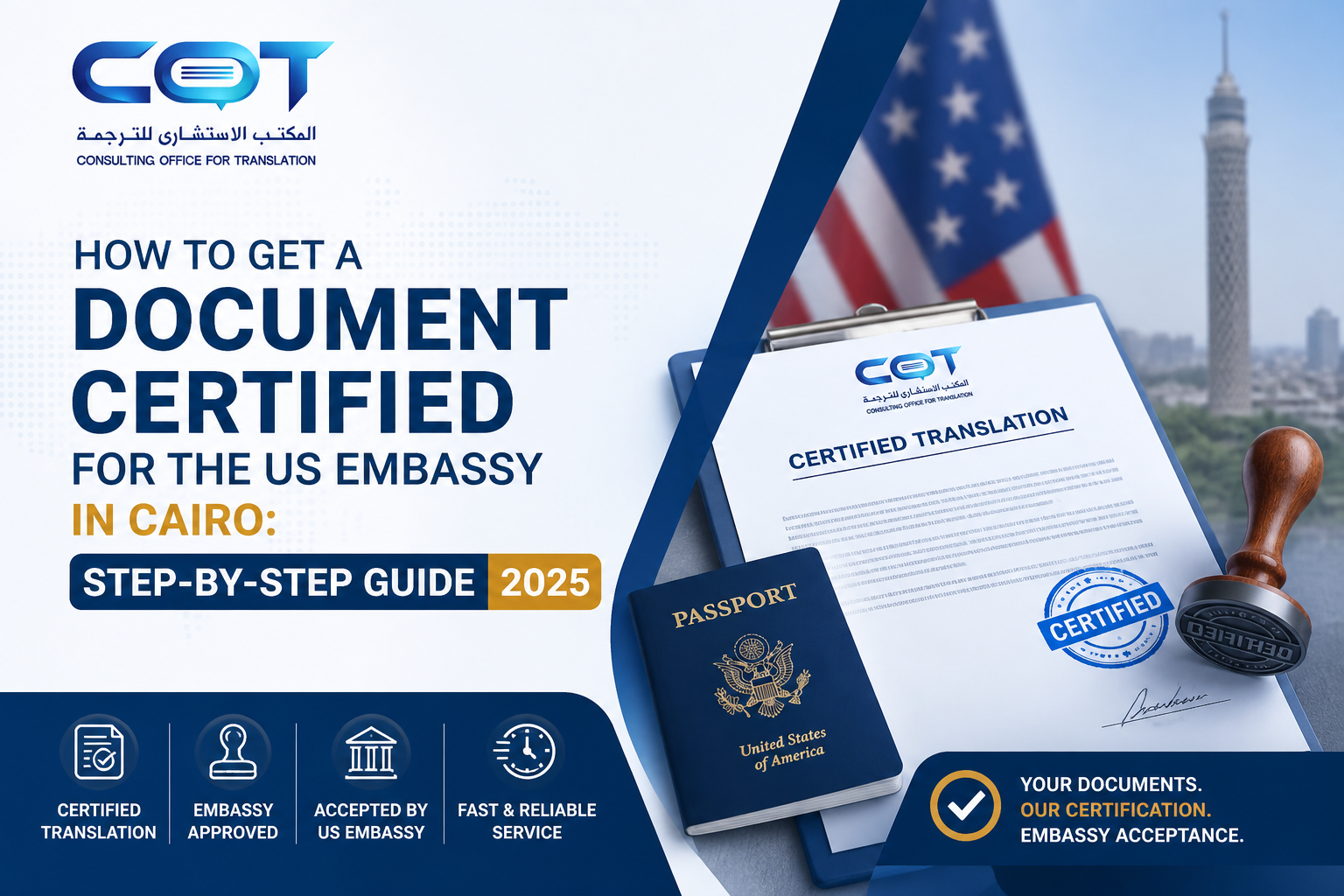
How to Get a Document Certified for the
US Embassy in Cairo
Planning to apply for a US visa, green card, or immigration benefit from Egypt? One of the most overlooked — and most important — steps is getting your documents properly translated and certified for the US Embassy in Cairo.
A single error in your certified translation can lead to delays, rejection, or costly re-submissions. This guide walks you through every step of the process so you can move forward with confidence in 2025.
Why Embassy-Certified Translation Matters
The US Embassy in Cairo — and USCIS (US Citizenship and Immigration Services) — requires that all non-English documents submitted with visa or immigration applications must be accompanied by a complete, accurate English translation certified by a qualified translator.
This is not optional. Under 8 CFR 103.2(b)(3), every foreign-language document submitted to USCIS must include a full English translation along with a certification statement confirming the translator’s competence and the accuracy of the translation.
📌 Key fact: The US Embassy in Cairo does not maintain a list of approved translators — but the translation must be performed by a translator who certifies their own competency. Choosing an experienced, professional agency eliminates risk.
Whether you are applying for an immigrant visa, a non-immigrant visa (B1/B2, F1, H1B), or submitting documents through the National Visa Center (NVC), embassy-approved translation is a foundational requirement you cannot skip.
→ Legal Translation Services
→ Certified Translation Services
Which Documents Need Certified Translation?
Nearly any official document issued in Arabic (or another language) must be translated if submitted to the US Embassy or USCIS. The most commonly required documents include:
- Birth certificates — required for almost all visa categories
- Marriage and divorce certificates — for spousal visa applications (IR-1, CR-1, K-1)
- National ID cards (بطاقة الرقم القومي) — as proof of identity
- Police clearance certificates (فيش وتشبيه) — required for immigrant visas
- Academic transcripts and diplomas — for student or skilled worker visas
- Military service records — for male applicants in many categories
- Death certificates — for widows/widowers filing for benefits
- Adoption papers — for IR-3 and IR-4 visa categories
- Court judgments and legal documents — when applicable to the case
⚠️Important: Photocopies of original documents are not acceptable. Always submit certified translations of the original or officially notarized copies. Submitting incomplete translations is one of the leading causes of embassy case delays in Egypt.
Step-by-Step: Getting Your Document Certified for the US Embassy in Cairo
Follow these steps carefully to ensure your translated documents meet all US Embassy requirements:
-
1
Gather Your Original Documents
Collect all Arabic-language documents required for your visa category. Make sure they are original or officially notarized by the Egyptian authority that issued them (e.g., Ministry of Interior, Civil Registry, or courts).
-
2
Select a Professional Certified Translator in Cairo
Choose a translation agency recognized by embassies and government bodies. The translator must be qualified in both Arabic and English and prepared to sign a certification statement. Avoid using freelance translators who lack verifiable credentials or institutional backing.
-
3
Submit Documents for Translation
Provide the originals or clear, high-resolution scans to your chosen agency. For sensitive documents like birth or police records, reputable agencies offer secure digital submission and encrypted delivery options.
-
4
Review the Translated Document
Before certification, carefully review the translated text for any errors in names, dates, or official references. Mistakes in translated proper nouns — even minor ones — can trigger embassy queries or rejections.
-
5
Obtain the Certification Statement
The certified translation must include a signed statement from the translator (or agency) confirming: (a) they are competent in both languages, and (b) the translation is accurate and complete to the best of their knowledge. This statement must appear on the same document or as an attachment.
-
6
Notarization (If Required)
Some visa categories or consular officers may request a notarized translation — where a notary public verifies the translator’s signature. Confirm with your immigration attorney or the NVC whether this is needed for your specific case.
-
7
Submit to the US Embassy or NVC
Include the certified translation alongside the original document in your application package. Never submit a translation without the original — both must be submitted together. Keep copies for your own records.
How to Choose the Right Certified Translator in Cairo 2025
Not all translators are equal — and when it comes to US Embassy submissions, the stakes are too high to cut corners. Here is what to look for when selecting a certified translator in Cairo:
✅ Key Criteria
- Embassy recognition: The agency should be recognized by multiple embassies in Cairo, including the American, British, French, and EU embassies.
- Native-level Arabic–English expertise: Translation accuracy depends on cultural and linguistic fluency in both directions.
- Signed certification: The agency must provide a signed, dated certification statement on official letterhead.
- Track record with immigration documents: Ask specifically about experience with birth certificates, police clearances, and civil registry documents.
- Confidentiality policy: Sensitive documents (ID cards, police records) require secure handling and data protection guarantees.
- Turnaround time: Embassy deadlines are firm. Confirm the agency can meet your submission window — same-day or 24-hour services are available for urgent cases.
| Feature | Professional Agency (COT) | Freelancer / Online Tool |
|---|---|---|
| Embassy-recognized certification | ✔ Yes | ✘ Often not |
| Signed certification statement | ✔ Yes | ✘ Varies |
| Legal document expertise | ✔ Specialized team | ✘ Generalist |
| Secure document handling | ✔ Encrypted delivery | ✘ No guarantee |
| Doorstep delivery (Cairo) | ✔ Available | ✘ No |
5 Costly Mistakes to Avoid When Submitting Certified Translations
1. Using Machine Translation (Google Translate, DeepL)
Automated tools cannot provide the signed certification statement required by USCIS and the US Embassy. Submitting a machine-generated translation — even if accurate — will result in rejection.
2. Translating Only Parts of the Document
USCIS regulations require a complete translation of every element on the document: headers, stamps, seals, handwritten notes, and official remarks. Partial translations are grounds for rejection.
3. Ignoring Name Transliteration Standards
Your name must appear in the translation exactly as it is spelled on your passport. Even a minor variation — “Mohamed” vs. “Mohammed” — can trigger a query from the consular officer.
4. Submitting Expired or Non-Original Documents
Documents like police clearance certificates have validity periods (typically six months). Ensure all originals are current before commissioning their translation.
5. Working with an Unrecognized Translator
Always verify the agency’s embassy recognition status. A translation signed by an unqualified individual carries no legal weight and will be rejected outright.
Timeline & Costs: What to Expect in 2025
Understanding the time and cost involved helps you plan your visa application without last-minute stress.
Typical Turnaround Times
- Standard delivery: 1–3 business days for most civil documents
- Express delivery: Same day or next morning for urgent embassy deadlines
- Complex legal documents: 2–5 business days depending on volume and content
- Notarized translations: Add 1 business day for notarization process
Cost Factors
Pricing for certified translation in Egypt is typically calculated per page or per word, with variations based on:
- Document type and complexity (birth certificate vs. legal judgment)
- Urgency of delivery (standard vs. same-day)
- Need for additional notarization or apostille
- Number of documents in a single submission package
💡 Pro tip: If you have multiple documents to translate for the same application (birth certificate, marriage certificate, police clearance), submitting them as a package to one agency saves time, ensures consistency in name transliteration, and often comes at a reduced combined rate.
Frequently Asked Questions
Does the US Embassy in Cairo have a list of approved translation agencies?
No. The US Embassy does not maintain or endorse a specific list of approved translators. However, the translation agency must be able to provide a signed certification statement confirming translator competency and translation accuracy, as required by USCIS.
Can I translate my own documents for the US Embassy?
You may translate your own documents only if you are fluent in both languages and include the required certification statement. In practice, self-translations are heavily scrutinized and frequently rejected. For any immigration-related submission, professional certified translation is strongly recommended.
Do I need to submit the original Arabic document alongside the translation?
Yes. Always submit the original document (or a notarized copy) together with its certified English translation. Never submit a translation alone.
What is the difference between certified and notarized translation?
A certified translation includes a signed statement from the translator confirming accuracy and competency. A notarized translation goes one step further — a notary public witnesses and stamps the translator’s signature, adding an extra layer of legal authentication. The US Embassy typically requires certified translations; notarization may be required for specific document types.
How long is a certified translation valid for the US Embassy?
Translations themselves do not expire. However, the original documents they translate may have validity periods (police clearance certificates, for example, are typically valid for 6 months). Always renew the original before commissioning a new translation if you are resubmitting.
Ready to Get Your Documents Certified?
COT Translation provides embassy-approved certified translations accepted by the US Embassy in Cairo and consular offices across the UAE, Kuwait, and Jordan — delivered fast, securely, and to your door.
Get a Free Quote Today →
✓ Fast turnaround ✓ Embassy-recognized ✓ Secure online delivery