- admin
- certified translation, Certified Translation Cairo, COT Translation Services, D7 Visa, D8 Visa, Embassy of Portugal Cairo, Family Reunification Visa Portugal, Lisbon, Porto, Portugal Residency Visa, Portugal Student Visa, Portugal Travel Guide, Portugal Visa, Portugal Visa from Egypt, Portugal Work Visa, Portuguese Consulate Egypt, Schengen Visa, Schengen Visa Egypt, sworn translation Egypt, VFS Global Egypt, VFS Portugal Appointment
- 0 Comments
- 819 Views
Portugal Visa from Egypt: Complete Guide to the Cairo Embassy, VFS Appointments & Document Translation
Applying for a Portugal visa from Egypt involves three separate players — the Embassy of Portugal in Cairo, the visa application centre that handles your biometrics and paperwork, and, in most cases, a certified translation office that converts your Arabic documents into a language the Portuguese authorities accept. Mixing up these roles is the single biggest reason applications get delayed. This guide walks you through every stage: the embassy’s real function, the visa types Egyptian residents can apply for, how appointment booking actually works, which documents need certified translation, and what to know about Portugal itself before you land.
The Embassy of Portugal in Cairo: What It Actually Handles
The Portuguese Embassy sits in Zamalek and is the diplomatic and consular representation of Portugal in Egypt. It is important to understand that the embassy is not where most visa applicants submit their paperwork — its consular section deals with civil registration, passports and ID cards for Portuguese citizens, official certificates, and legalisation/translation-related consular acts. Visa applications, by contrast, are processed through a separate visa application centre (more on that below).
Embassy of Portugal in Cairo — Contact Details
- Address: 25 Ahmed Heshmat Street, Zamalek, Cairo
- Embassy phone: +20 2 2735 0779 / +20 2 2735 0781
- Visa section phone: +20 2 2735 5431
- General email: cairo@mne.pt
- Consular section email: sconsular.cairo@mne.pt
- Visa matters email: vistos.cairo@mne.pt
The embassy asks applicants to contact the correct department by email for the matter at hand — a message about a visa sent to the consular address, or vice versa, is typically not processed. If your enquiry concerns civil registration, certificates, or the notarisation/translation of official Portuguese documents, the consular section is who you need; if it concerns an actual visa application, you’ll be redirected to the visa centre.
Portugal Visa Types Available to Applicants from Egypt
Portugal, as a Schengen member, issues several visa categories depending on your purpose of travel and length of stay. The most common ones requested from Egypt are:
| Visa Type | Purpose | Typical Duration |
|---|---|---|
| Schengen (Type C) Tourist Visa | Tourism, family visits, short business trips | Up to 90 days within 180 days |
| Student Visa (Type D) | University or language programs in Portugal | Long-stay, renewable |
| D7 Visa | Passive income / retirement residency | Long-stay, renewable |
| D8 Visa | Digital nomads / remote workers | Long-stay, renewable |
| Work Visa (Type D) | Employment contract in Portugal | Long-stay, renewable |
| Family Reunification Visa | Joining a family member residing in Portugal | Long-stay, renewable |
Short-stay Schengen visas are the most frequent request among tourists and business travellers, while the D7 and D8 categories have grown in popularity with remote professionals and retirees looking to relocate. Each category has its own document checklist, and the checklist can change, so always confirm the current requirements on the official visa centre portal before your appointment.
Where You Actually Submit Your Portugal Visa Application
Since 2022, Portugal’s visa applications from Egypt are processed through VFS Global, operating as a joint visa application centre in Cairo. Applicants do not submit documents directly at the embassy; instead, they book a slot at the visa centre, where staff verify the checklist, collect biometric data (fingerprints and photo), take the visa fee, and forward the complete file to the Portuguese consular section for a final decision.
Visa Application Centre — Cairo
52 Lebanon Street, Mohandessin/Agouza, Giza, Cairo (joint visa application centre serving Portugal and several other Schengen states). Appointment slots and the current checklist are published on the official visa centre booking portal for your visa category — always check the latest version before your appointment, as requirements are updated periodically.
How to Book a Portugal Visa Appointment: Step by Step
- Identify your visa category. Confirm whether you need a Schengen (C) visa or a long-stay (D) visa such as D7, D8, student, or work — the checklist differs for each.
- Download the official checklist for that category from the visa centre’s website and read it carefully, including photo specifications, document validity windows, and translation requirements.
- Gather and organise your documents — passport, application form, photos, proof of accommodation, financial means, travel insurance, and any category-specific paperwork (enrolment letter, employment contract, NIF number for D7/D8, etc.).
- Translate and certify any document not in Portuguese or English before your appointment (see the next section) — this is where most last-minute rejections happen.
- Book your slot online through the visa centre’s appointment system. Availability can be limited, especially in peak travel seasons, so check regularly and book as early as possible.
- Attend in person with your original documents plus one photocopy of each, arrive at least 15–30 minutes early, and pay the visa fee plus the service fee at the centre.
- Track your application using the reference code provided after submission until a decision is issued.
For long-stay visas like the D7 or D8, applicants are also generally expected to obtain a Portuguese tax number (NIF) and proof of accommodation — a lease agreement or a “Term of Responsibility” from a Portuguese resident — before the appointment, since these can be requested at the interview or at the decision stage.
Which Documents Need Certified Translation — and Into What Language
This is the part of the process that trips up the most applicants. Portuguese consular authorities require any document not originally issued in Portuguese or English to be translated by a certified/sworn translator before submission. In practice, English is the most commonly accepted translation language for Portugal visa files from Egypt, though some case officers may specifically request Portuguese — it’s always worth confirming this detail against your specific checklist, since requirements can vary slightly by visa category and change over time.
Documents that typically require certified translation when originally issued in Arabic include:
- Birth certificates
- Marriage and divorce certificates
- Police clearance / criminal record certificates
- Bank statements and proof of financial means
- University degrees and academic transcripts
- Employment contracts and salary letters
- Power of attorney and other notarised documents
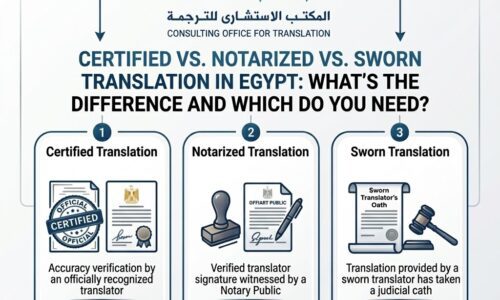
A translation is only useful to a visa officer if it is certified — meaning it carries an official stamp, signature, and a statement of accuracy from a recognised translation office, not a casual or self-translated version. This is precisely the role a professional, embassy-experienced translation office plays in the process.
The Role of a Certified Translation Office in Your Visa Journey
COT — Consulting Office for Translation is a certified translation office in Cairo with over three decades of experience preparing embassy-compliant translations for Schengen countries, including Portugal. Rather than translating a document literally, COT’s linguists format and phrase each translation the way Portuguese and other Schengen consulates expect to see it, which significantly reduces the chance of a document being questioned or rejected at intake.
Why applicants use a certified office instead of translating documents themselves:
- Translations are stamped, signed, and legally recognised by embassies, courts, and ministries in Egypt and abroad
- Coverage of Portuguese, English, and 30+ other language pairs
- Same-day and express turnaround for last-minute embassy appointments
- Familiarity with the exact checklist format used by VFS Global and other Schengen visa centres in Cairo
- Multiple branches across Cairo (Downtown, Maadi, Mohandessin) for easy access
If you’re preparing a Schengen file more broadly, our detailed walkthrough on certified translation for a Schengen visa from Egypt covers the requirements shared across France, Germany, Italy, Spain, and Portugal. For applicants racing against the clock, see our guide to same-day translation for last-minute embassy appointments, and if you’re a student or short-term visitor, our piece on certified translation for tourist and student visa applications breaks down exactly what to bring.
Need your documents translated for a Portugal visa appointment?
Call or WhatsApp COT Translation Services: +20 120 544 4602
Getting to Know Portugal: Geography, People, and Cities
Portugal occupies the western edge of the Iberian Peninsula, bordered by Spain to the north and east and the Atlantic Ocean to the west and south. It also includes two autonomous archipelagos — Madeira and the Azores — known for their volcanic landscapes and mild, oceanic climate. With a population of roughly 10.5 million people, Portugal is one of the more compact countries in Western Europe, but its geography is remarkably varied: rolling vineyard-covered hills in the Douro Valley, dramatic cliffs along the Algarve coast, forested mountains in the north, and flat agricultural plains further south.
Portugal has a Mediterranean-influenced climate along most of its coast, with warm, dry summers and mild, rainy winters — a major draw for retirees, remote workers, and long-stay visa applicants seeking a comfortable year-round environment. Portuguese is the official language, though English is widely spoken in major cities and tourist areas, which is part of why English-language document translations are so commonly accepted by Portuguese authorities.
Beyond the climate, Portugal is consistently ranked among the safer, more affordable countries in Western Europe, which has made it a popular relocation choice for Egyptian and other international applicants over the past several years. The cost of living remains lower than in France, Germany, or the UK, particularly outside Lisbon and Porto, while healthcare, public transport, and infrastructure are well developed. The country’s EU and Schengen membership also means that a Portuguese residency permit opens up visa-free travel across most of Europe, which is one of the reasons the D7 and D8 categories have become especially popular among remote professionals and retirees applying from Egypt.
Top Cities Worth Knowing Before You Apply
- Lisbon — the capital and largest city, known for its hillside neighbourhoods, historic trams, and growing tech and startup scene.
- Porto — Portugal’s second-largest city in the north, famous for port wine, the Douro River, and a well-preserved historic centre.
- Faro and the Algarve — the southern coastal region, popular with tourists and retirees for its beaches and warm climate.
- Coimbra — home to one of Europe’s oldest universities, a common destination for student visa applicants.
- Braga — a historic northern city known for its churches and growing student population.
For remote workers and retirees applying for a D7 or D8 visa, the choice of city often shapes the rest of the application — proof of accommodation, cost-of-living calculations, and even NIF registration are usually tied to where in Portugal you plan to settle.
How Long Does a Portugal Visa Take, and What Does It Cost?
Processing times vary by visa category and by how complete your file is at submission. A Schengen (Type C) visa typically takes a few weeks once the file reaches the consular section, though this can extend during peak travel periods. Long-stay visas such as the D7, D8, student, or work visas generally take longer, since the consulate reviews financial documentation, accommodation proof, and — for D7/D8 applicants — income verification in more depth. Applying well ahead of your intended travel date is strongly advised for any category, and long-stay applicants in particular should expect the process, from document preparation to final decision, to take several weeks to a few months.
Two separate fees apply at the visa centre: the consular visa fee paid to the Portuguese authorities, and a service fee charged by the visa application centre for handling your appointment, biometrics, and file forwarding. Fees differ by visa category and can change, so always confirm the current amounts on the official visa centre portal before booking. Certified translation costs are separate and are charged by the translation office per document, based on length and complexity — most offices in Cairo can provide a free quote once they’ve reviewed your document list.
Common Mistakes That Delay a Portugal Visa Application
- Submitting documents to the embassy instead of the visa application centre
- Using an uncertified or self-made translation instead of a certified one
- Booking the wrong visa subcategory (e.g., booking “Schengen” when applying for a D7 residency visa)
- Arriving without photocopies of original documents
- Missing the NIF number or proof of accommodation for long-stay visas
- Waiting until the last minute to translate documents, then scrambling for same-day service
If you want a broader look at how translation offices are evaluated by embassies across Cairo, our article on the best translation office in Cairo for embassy and legal documents compares turnaround times, language coverage, and certification standards you should look for.
Frequently Asked Questions
Do I apply for a Portugal visa at the embassy or at VFS Global?
You submit your application, biometrics, and documents at the visa application centre in Cairo (currently operated in partnership with VFS Global), not at the embassy itself. The embassy’s consular section handles separate matters such as civil registration and certificates for Portuguese citizens.
What language should my Arabic documents be translated into for a Portugal visa?
English is the most commonly accepted language for supporting documents, though Portuguese is also accepted and occasionally specifically requested. Always confirm the exact requirement listed on your visa category’s official checklist, as this can vary by case.
Can I translate my own documents for the visa application?
No. Portuguese consular authorities require certified translations produced by a recognised translation office that stamps, signs, and certifies the accuracy of the translation — self-translated or informal versions are not accepted.
How long does certified translation for a Portugal visa take?
Standard turnaround with most certified offices in Cairo is 1–3 business days, with same-day or express service available for urgent embassy appointments, depending on the number and complexity of documents.
What is the difference between a D7 and a D8 visa?
The D7 visa is designed for applicants with passive income, such as pensions or investment income, while the D8 is aimed at remote workers and digital nomads earning income from employment or freelance work outside Portugal. Both are long-stay residency visas with different proof-of-income requirements.
Do I need a Portuguese tax number (NIF) before my appointment?
For long-stay visas such as the D7 or D8, a NIF is generally required to finalise the visa, and it’s often requested during the review of your application. It’s advisable to arrange this as early as possible in the process.
Where is the Portugal visa application centre located in Cairo?
The joint visa application centre is located at 52 Lebanon Street, Mohandessin/Agouza, Giza, Cairo. Always confirm the current address and hours on the official booking portal before your appointment, as visa centre logistics can change.
Get embassy-compliant certified translation for your Portugal visa file today.
Call or WhatsApp COT Translation Services: +20 1111760177 — Downtown, Maadi & Mohandessin branches, Cairo.