- admin
- certified pharmaceutical translation, clinical trial translation Egypt, COT translation, CTD translation Arabic, drug leaflet translation Egypt, drug registration translation EDA, English to French pharma translation, French Arabic pharmaceutical translation, French to English pharma translation, GMP certificate translation, medical translation Cairo, patient information leaflet translation, pharma translation services Egypt, pharmaceutical translation Egypt, pharmacovigilance translation Egypt, PIL translation Arabic, regulatory translation Egypt, SmPC translation Arabic, ترجمة صيدلانية معتمدة, ترجمة نشرة دوائية
- 0 Comments
- 1061 Views
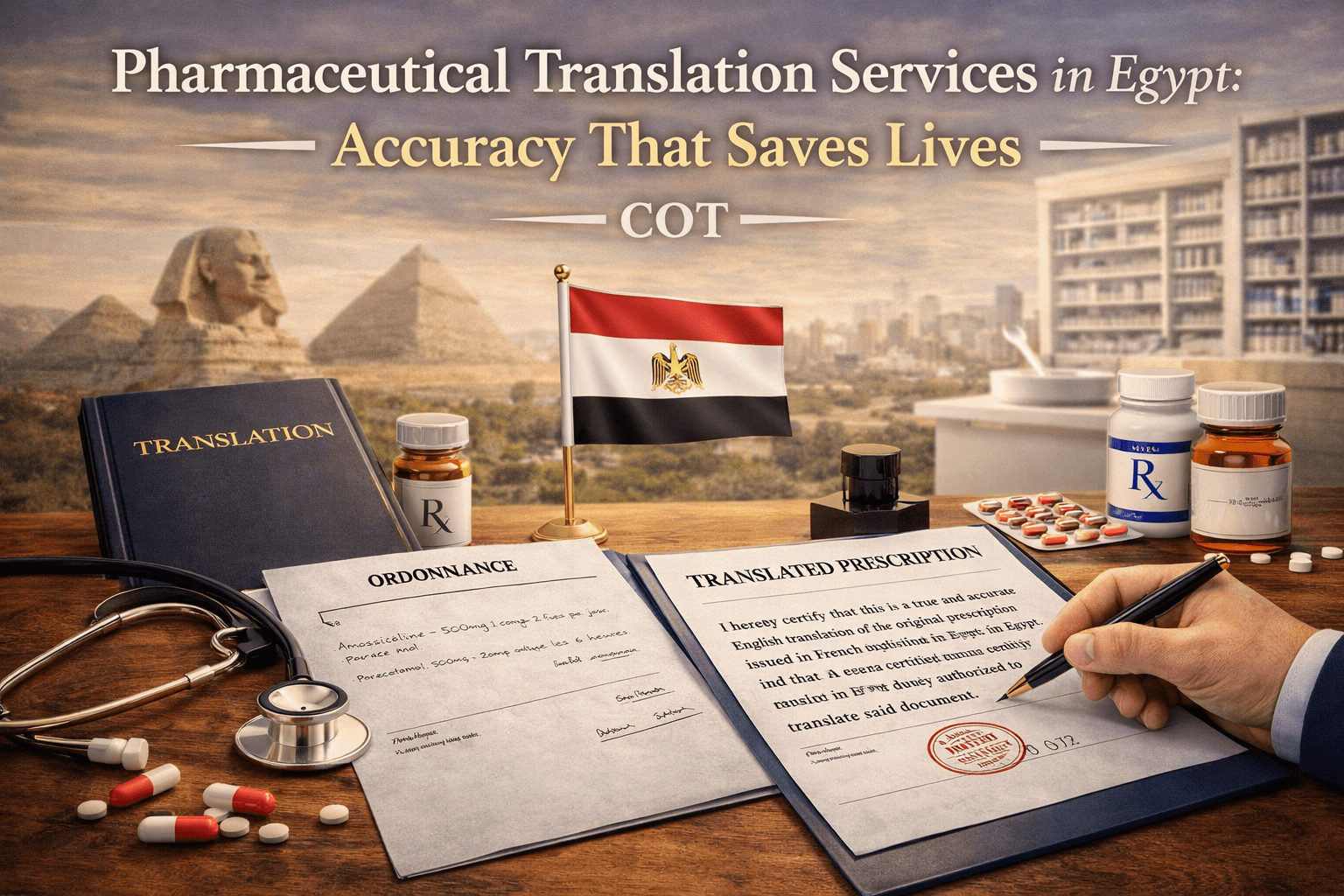
Pharmaceutical Translation Services in Egypt: Accuracy That Saves Lives | COT
In the pharmaceutical industry, a single mistranslated word can mean the difference between a correct dosage and a fatal error, between regulatory approval and a rejected submission, between a drug reaching patients who need it and years of costly delays. Pharmaceutical translation is not just a language service — it is a patient safety measure.
Egypt’s pharmaceutical market is one of the largest and fastest-growing in the Middle East and Africa, with the Egyptian Drug Authority (EDA) enforcing strict requirements for Arabic-language documentation on all registered products. At the same time, Egypt’s pharma sector works extensively with international partners, regulators, and research organizations that operate in English, French, German, and dozens of other languages.
🌍 Why Multilingual Pharma Translation Matters in Egypt:
A significant portion of pharmaceutical documentation entering and leaving Egypt involves French ↔ English and French ↔ Arabic translation — particularly for products originating from or destined for Francophone African markets (Morocco, Tunisia, Algeria, Senegal, Côte d’Ivoire), as well as French and Belgian pharmaceutical companies operating in the region. COT Translation handles these language pairs with native-level fluency in all three languages, plus over 120 additional languages for global pharma needs.
This guide explains the full scope of pharmaceutical translation services in Egypt, the types of documents involved, the regulatory context, the critical importance of multilingual capability, and why COT Translation is the trusted partner for pharma companies, hospitals, clinical research organizations, and regulatory bodies across Egypt and the Arab world.
📋 Table of Contents
- Why the Pharmaceutical Industry Needs Specialized Translation
- Pharmaceutical Documents That Require Certified Translation
- The Multilingual Dimension: French, English, Arabic, and Beyond
- Drug Registration and EDA Submission Translation
- Clinical Trial Document Translation
- Patient Information Leaflet (PIL) Translation
- Pharmacovigilance and Safety Document Translation
- The Pharmaceutical Translation Process at COT
- 9 Pharmaceutical Translation Errors That Cost Lives and Millions
- What Our Clients Say About COT Translation
- Why Choose COT for Pharmaceutical Translation in Egypt
- Frequently Asked Questions
1. Why the Pharmaceutical Industry Needs Specialized Translation
Pharmaceutical translation sits at the intersection of medicine, law, science, and regulation. It is one of the most demanding forms of translation in existence, and for good reason: the documents being translated directly affect whether patients live or die, whether drugs are approved or rejected, and whether companies face lawsuits or compliance.
Here is what makes pharmaceutical translation fundamentally different from general or even standard medical translation:
- Zero tolerance for error — A mistranslated active ingredient, a wrong dosage unit (mg vs. mcg), or an incorrectly translated contraindication can cause patient harm. There is no “close enough” in pharma translation.
- Regulatory consequences — The Egyptian Drug Authority (EDA), the US FDA, the European Medicines Agency (EMA), and every national regulatory body require that submissions be linguistically precise and compliant with local language requirements. A translation error can trigger rejection, delays, or withdrawal of a marketing authorization.
- Legal liability — Pharmaceutical companies are legally responsible for the accuracy of all documentation associated with their products, including translations. An inaccurate translation of a drug leaflet or informed consent form can become the basis for litigation.
- Highly specialized terminology — Pharmaceutical documents use terminology drawn from pharmacology, biochemistry, clinical medicine, regulatory science, and law. A translator must be fluent in all of these domains simultaneously.
- Confidentiality requirements — Clinical trial data, drug formulations, and regulatory strategies are proprietary. Pharmaceutical translation must be performed under strict confidentiality agreements.
For a broader discussion of why human expertise is irreplaceable in high-stakes translation, read our article on whether AI can replace human translators.
2. Pharmaceutical Documents That Require Certified Translation
The range of documents involved in pharmaceutical translation is extensive. At COT Translation, we provide certified translation for every document type in the pharmaceutical lifecycle:
Drug Registration and Regulatory Submissions
- Common Technical Document (CTD) modules and summaries
- Drug registration dossiers for EDA, FDA, EMA, and other authorities
- Certificate of Pharmaceutical Product (CPP)
- Good Manufacturing Practice (GMP) certificates and inspection reports
- Pricing and reimbursement documentation
- Variation and renewal applications
Clinical Trial Documentation
- Clinical study protocols and amendments
- Informed consent forms (ICFs)
- Investigator brochures
- Case report forms (CRFs)
- Patient-reported outcome (PRO) instruments
- Clinical study reports (CSRs)
- Ethics committee submissions
Patient-Facing Documents
- Patient Information Leaflets (PILs / package inserts)
- Summary of Product Characteristics (SmPC)
- Medication guides and patient education materials
- Prescription and dosage instructions
- Drug labeling and packaging text
Safety and Pharmacovigilance
- Adverse event reports and Individual Case Safety Reports (ICSRs)
- Periodic Safety Update Reports (PSURs)
- Risk Management Plans (RMPs)
- Development Safety Update Reports (DSURs)
Corporate and Legal Pharmaceutical Documents
- Licensing and distribution agreements
- Manufacturing and supply contracts
- Intellectual property and patent documentation
- Regulatory correspondence with health authorities
- Quality management and SOP documentation
For medical test results, lab reports, and hospital documentation, see our dedicated page on medical test translation services in Egypt.
3. The Multilingual Dimension: French, English, Arabic, and Beyond
One of the most critical — and often underestimated — aspects of pharmaceutical translation in Egypt is the multilingual nature of the industry. Egypt’s pharma sector does not operate in Arabic and English alone. French is a major pharmaceutical language, and its role in Egypt’s translation needs is far more significant than many realize.
🇫🇷 Why French Matters in Egyptian Pharmaceutical Translation:
Egypt is a manufacturing and distribution hub for pharmaceutical products serving Francophone Africa — a market of over 400 million people across more than 20 countries. Drug leaflets, registration dossiers, clinical trial documents, and patient materials for these markets must be translated into French with the same regulatory precision as Arabic or English documents.
The most common multilingual pharmaceutical translation scenarios we handle at COT include:
- French → English — Translating drug dossiers, clinical trial reports, and SmPC documents from French pharmaceutical companies (Sanofi, Servier, Pierre Fabre, Ipsen, etc.) into English for EDA submission or international regulatory alignment.
- English → French — Translating drug registration documents, patient leaflets, and labeling from English into French for distribution in Francophone African markets (Morocco, Tunisia, Algeria, Senegal, Côte d’Ivoire, Cameroon, Democratic Republic of Congo, etc.).
- French → Arabic — Translating regulatory documents and patient-facing materials from French-origin products into Arabic for the Egyptian market and other Arab countries.
- Arabic → French — Translating Egyptian pharmaceutical research, regulatory correspondence, and clinical data into French for Francophone partners, regulators, and journals.
- Arabic → English — Translating EDA regulatory documents, local clinical trial data, and pharmacovigilance reports from Arabic into English for international regulatory bodies and multinational pharma partners.
- English → Arabic — Translating drug registration dossiers, SmPCs, PILs, and labeling from English into Arabic for the Egyptian market as required by the EDA.
Beyond these three core languages, COT provides pharmaceutical translation in German, Italian, Spanish, Portuguese, Chinese, Japanese, Korean, Russian, Turkish, and over 110 additional languages — covering every major pharmaceutical market in the world.
💡 Direct Translation — No Intermediate Language:
At COT, we translate directly between language pairs (e.g., French → Arabic, German → Arabic, Chinese → English) without using English as an intermediate step. This eliminates the “double translation” problem that introduces errors and dilutes meaning. Your French clinical trial protocol is translated directly into Arabic by a translator fluent in both languages and trained in pharmaceutical terminology.
4. Drug Registration and EDA Submission Translation
The Egyptian Drug Authority (EDA) requires that all pharmaceutical products marketed in Egypt undergo a formal registration process. This process involves the submission of extensive documentation — and the EDA requires Arabic-language versions of key documents, including the Patient Information Leaflet (PIL) and labeling.
For imported pharmaceutical products, the registration dossier typically originates in English, French, or German and must be translated with absolute precision into Arabic. The translation must preserve the exact meaning of every scientific term, dosage instruction, contraindication, and regulatory claim.
COT Translation supports pharma companies through every stage of the EDA registration process:
- Pre-submission translation — Translating the CTD modules, quality documentation, and pre-clinical/clinical summaries required for initial applications.
- PIL and SmPC translation — Producing Arabic translations of patient leaflets and product characteristics that meet EDA formatting and terminology standards.
- Labeling translation — Translating primary and secondary packaging text, including drug name, strength, dosage form, excipients, storage conditions, and expiry date.
- Variation and renewal translation — Translating updated documentation for post-approval changes, line extensions, and periodic renewals.
- Regulatory correspondence — Translating EDA queries, deficiency letters, and company responses between Arabic and English or French.
Our translators are familiar with the specific terminology, formatting requirements, and submission standards of the EDA, CAPA (Central Administration for Pharmaceutical Affairs), and NODCAR (National Organization for Drug Control and Research).
5. Clinical Trial Document Translation
Egypt is an increasingly important country for clinical research, with a growing number of multinational pharmaceutical companies conducting clinical trials across Egyptian hospitals and research centers. Every clinical trial conducted in Egypt requires translation of key documents into Arabic for local ethics committees, investigators, and participants.
At the same time, Egyptian clinical data must be translated from Arabic into English (or French, for Francophone sponsors) for inclusion in global regulatory submissions and scientific publications.
Critical clinical trial documents that require certified pharmaceutical translation include:
- Informed Consent Forms (ICFs) — The most sensitive clinical trial document. Participants must fully understand the risks, benefits, procedures, and their rights. The Arabic translation must be linguistically accurate, culturally appropriate, and legally binding. For trials sponsored by French companies, ICFs may also need French → Arabic direct translation.
- Clinical Study Protocols — The master document governing the trial’s methodology, endpoints, and procedures. Any mistranslation can compromise the integrity of the entire study.
- Investigator Brochures — Comprehensive documents summarizing all known data about the investigational product, translated for local investigators who may not read the source language.
- Patient-Reported Outcome (PRO) Instruments — Questionnaires and scales completed by patients, requiring not just translation but linguistic validation to ensure cross-cultural equivalence.
- Ethics Committee Submissions — Regulatory and ethical review documents that must be presented in Arabic for Egyptian institutional review boards.
- Adverse Event and Safety Reports — Time-sensitive documents that must be translated rapidly and accurately to ensure patient safety across multinational trial sites.
COT understands the urgency of clinical trial timelines. We offer priority and same-day translation for time-sensitive clinical documents, with dedicated project managers for ongoing trial support.
6. Patient Information Leaflet (PIL) Translation
The Patient Information Leaflet — the paper insert that accompanies every medicine box — is arguably the most widely read pharmaceutical document in the world. The EDA requires that most authorized medicinal products in Egypt include an Arabic PIL, in addition to the English SmPC.
PIL translation is deceptively complex. It must be:
- Scientifically accurate — Every active ingredient, dosage, contraindication, side effect, and drug interaction must be translated with zero error.
- Readable by patients — Unlike regulatory submissions (which are read by scientists), PILs are read by ordinary patients. The Arabic translation must use clear, accessible language while maintaining scientific precision.
- Culturally appropriate — Some medical topics (psychiatric conditions, reproductive health, sexual side effects) require sensitivity to cultural norms in the Arabic-speaking world. A skilled translator navigates this without sacrificing medical completeness.
- Formatted for print — PIL translations must fit the physical dimensions of the package insert, often requiring careful management of text expansion (Arabic text is typically 20–30% longer than English) and right-to-left layout.
For products distributed across both Arabic and Francophone markets, COT produces parallel PILs in Arabic and French from a single English or French source — ensuring consistency across both language versions and full compliance with each market’s regulatory requirements.
7. Pharmacovigilance and Safety Document Translation
Pharmacovigilance — the monitoring of drug safety after a product reaches the market — generates a constant stream of documents that require rapid, accurate translation. When an adverse event is reported in Egypt, the report must be translated and communicated to the global safety database of the marketing authorization holder, often in English or French.
Key pharmacovigilance documents we translate include:
- Individual Case Safety Reports (ICSRs) — Detailed reports of suspected adverse drug reactions, often time-sensitive and subject to strict regulatory deadlines.
- Periodic Safety Update Reports (PSURs) — Comprehensive safety reviews submitted at regular intervals to regulatory authorities worldwide.
- Risk Management Plans (RMPs) — Documents outlining the known and potential risks of a product and the measures in place to minimize them.
- Dear Healthcare Professional Communications (DHPCs) — Urgent safety communications that must be translated and distributed rapidly to healthcare providers in the local language.
- Labeling updates — When safety findings require changes to product labeling, all language versions must be updated simultaneously.
The speed and accuracy of pharmacovigilance translation directly impacts patient safety. COT offers urgent and same-day pharmacovigilance translation services, with dedicated translators who understand the regulatory timelines and formatting requirements for safety reporting.
8. The Pharmaceutical Translation Process at COT
Pharmaceutical translation at COT follows a rigorous, multi-stage process designed to meet the highest standards of accuracy, consistency, and regulatory compliance:
- Document Intake and Assessment — You submit your document via secure email, WhatsApp, or in person at any of our three Cairo branches. Our project team assesses the document type, language pair, complexity, regulatory context, and deadline.
- Translator Assignment — The document is assigned to a translator with specific expertise in pharmaceutical translation and the relevant language pair. For French → English or English → French pharmaceutical documents, we assign translators with native fluency in both languages and proven pharma experience.
- Translation with Terminology Management — The translator produces the target text using approved pharmaceutical glossaries, style guides, and any client-specific terminology databases. Consistency of terminology across all documents is maintained rigorously.
- Review by a Second Pharmaceutical Linguist — A second translator or pharmaceutical editor reviews the entire translation for accuracy, completeness, terminology consistency, and formatting compliance.
- Quality Assurance Check — A final QA check verifies that all numbers, dosages, measurements, drug names, and regulatory terms are correct. This is a dedicated pass focused solely on factual accuracy.
- Certification and Delivery — The finalized translation receives COT’s official stamp and certificate of accuracy, and is delivered in the requested format (PDF, Word, print) ready for submission to the EDA, embassies, courts, or any regulatory body.
For large-scale and ongoing projects — such as full CTD dossier translations or clinical trial programs — we assign a dedicated project manager and maintain translation memories and glossaries to ensure consistency across all documents over time.
9. 9 Pharmaceutical Translation Errors That Cost Lives and Millions
Based on our decades of experience in pharmaceutical translation, these are the most dangerous and costly errors we see in the industry:
- Confusing mg with mcg (or μg) — This is a 1,000x dosage error. In pharmaceutical translation, measurement units must be verified character by character, not assumed from context.
- Mistranslating drug names across languages — The same active substance may have different trade names in different countries. Translating a trade name instead of the INN (International Nonproprietary Name) — or vice versa — can lead to dispensing the wrong medication.
- Using machine translation for regulatory documents — Google Translate, DeepL, and AI tools cannot produce regulatory-grade pharmaceutical translations. They miss context, confuse terms, and generate plausible-sounding but scientifically wrong output. No regulatory body accepts machine-translated submissions.
- Ignoring the French-Arabic or French-English pharmaceutical pipeline — Many pharma companies assume that all pharmaceutical documentation flows through English. In reality, a huge volume of pharmaceutical content originates in French, particularly from Francophone manufacturers, North African regulators, and West African health authorities. Failing to use translators who work directly with French — and instead routing through English as an intermediary — introduces compounded errors.
- Inconsistent terminology across documents — If a clinical trial protocol translates a term one way and the informed consent form translates it differently, the discrepancy can confuse investigators, ethics committees, and regulators — potentially invalidating the trial.
- Omitting or mistranslating contraindications — Contraindications tell patients and prescribers who should NOT take a drug. A missing or incorrectly translated contraindication is a direct patient safety hazard.
- Failing to account for Arabic text expansion in labeling — Arabic translations of pharmaceutical text are typically 20–30% longer than English. If the translation is not adapted for the physical dimensions of drug packaging, critical information may be truncated or reformatted in a way that confuses patients.
- Using non-specialized translators — A translator who lacks pharmaceutical knowledge may translate “excipient” as “ingredient,” “bioavailability” as “availability,” or “adverse reaction” as “side effect” — each of which has a distinct regulatory and medical meaning.
- Delaying translation until the end of the regulatory process — Translation should be integrated into the regulatory timeline from the start, not treated as a last-minute task. Late translation delays submissions, increases costs, and raises the risk of errors under time pressure.
10. What Our Clients Say About COT Translation
COT Translation serves pharmaceutical companies, clinical research organizations, hospitals, and regulatory professionals across Egypt and the Arab world. Here is what our clients say:
★★★★★
“COT is highly-qualified and always provides accurate, timely and dependable services in whatever language is needed.”
— International Pharmaceutical Client, Cairo
“COT is highly-qualified and always provides accurate, timely and dependable services in whatever language is needed.”
— International Pharmaceutical Client, Cairo
★★★★★
“I have read the translated quality control document a few times back to front, and must congratulate you on its accuracy.”
— Quality Assurance Manager, Pharma Company
“I have read the translated quality control document a few times back to front, and must congratulate you on its accuracy.”
— Quality Assurance Manager, Pharma Company
★★★★★
“I contacted COT to provide English and French certified translation of nearly 30 pages. They were fast and very professional. Best certified services.”
— Client Review, Downtown Cairo Branch
“I contacted COT to provide English and French certified translation of nearly 30 pages. They were fast and very professional. Best certified services.”
— Client Review, Downtown Cairo Branch
★★★★★
“Thanks for your excellent Translation services. We’re impressed with the high level of quality we received for our technical content. We’ll keep working with COT Translations.”
— Pharmaceutical Research Client, Mohandeseen Branch
“Thanks for your excellent Translation services. We’re impressed with the high level of quality we received for our technical content. We’ll keep working with COT Translations.”
— Pharmaceutical Research Client, Mohandeseen Branch
★★★★★
“المكتب ده معاملته حلوة جدا ويتميز بالدقة في ترجمته وسرعة الأداء وعن تجربة شخصية وأوصي من يحتاجون إلى ترجمة سريعة ومعتمدة ودقيقة بالتعامل معه”
— عميل من فرع المعادي
“المكتب ده معاملته حلوة جدا ويتميز بالدقة في ترجمته وسرعة الأداء وعن تجربة شخصية وأوصي من يحتاجون إلى ترجمة سريعة ومعتمدة ودقيقة بالتعامل معه”
— عميل من فرع المعادي
★★★★★
“ناس محترفين في الترجمة وسعرهم كويس جدا وخلصولي الشغل في نفس اليوم اول ما عرفوا أني عندي موعد في السفارة ومن غير رسوم مستعجل بصراحة قمة في الذوق”
— عميل من فرع وسط البلد
“ناس محترفين في الترجمة وسعرهم كويس جدا وخلصولي الشغل في نفس اليوم اول ما عرفوا أني عندي موعد في السفارة ومن غير رسوم مستعجل بصراحة قمة في الذوق”
— عميل من فرع وسط البلد
11. Why Choose COT for Pharmaceutical Translation in Egypt
COT Translation — the Consulting Office for Translation — has been Egypt’s trusted translation partner for over 30 years. Here is why pharmaceutical companies, CROs, hospitals, and regulatory professionals choose COT:
- Specialized Pharmaceutical Translators — Our pharma translation team includes professionals with backgrounds in pharmacology, medicine, chemistry, and regulatory science, ensuring every translation is scientifically and terminologically accurate.
- True Multilingual Capability — We translate directly between Arabic, English, and French — the three languages that dominate pharmaceutical documentation in Egypt and Francophone Africa — plus German, Italian, Spanish, Chinese, Japanese, Korean, Russian, Turkish, Portuguese, and over 110 additional languages. No intermediate language. No double-translation errors.
- French ↔ English Pharmaceutical Expertise — We maintain a dedicated team for French-English and English-French pharmaceutical translation, serving French pharmaceutical companies operating in Egypt, multinational companies distributing to Francophone African markets, and research organizations publishing in both languages.
- Official Accreditation — COT is recognized by all embassies in Egypt, the Ministry of Justice, all Egyptian courts, and government bodies. Our certified translations are accepted by the EDA, CAPA, hospitals, and every regulatory authority.
- Terminology Consistency — We maintain pharmaceutical glossaries and translation memories for each client, ensuring that terminology remains consistent across all documents within a project, across submissions, and over time.
- Confidentiality Guaranteed — All translators sign NDAs. We never upload pharmaceutical documents to public AI tools, machine translation platforms, or cloud services. Your clinical trial data, drug formulations, and regulatory strategies remain fully confidential.
- Fast Turnaround with Urgent Service — Most pharmaceutical documents are completed within 24–48 hours. Same-day and urgent services are available for time-sensitive pharmacovigilance reports, regulatory queries, and clinical trial documents.
- Three Cairo Branches + Online Ordering — Visit us in Downtown Cairo, Maadi, or Mohandeseen, or order securely via email and WhatsApp from anywhere in Egypt or the world.
- Institutional Service Agreements — For pharma companies and CROs with ongoing translation needs, we offer dedicated service agreements with priority handling, dedicated project managers, and volume pricing.
Your Pharmaceutical Documents Deserve Zero-Error Translation
From EDA registration to clinical trials to French ↔ English pharmaceutical documentation — COT delivers certified accuracy in every language.
📞 (+20) 1205444602 | ✉️ operation@cottranslation.com
12. Frequently Asked Questions
Does COT translate pharmaceutical documents from French to English and English to French?
Yes. French ↔ English pharmaceutical translation is one of our core specializations. We serve French pharmaceutical companies operating in Egypt, Egyptian companies exporting to Francophone Africa, and multinational organizations that require French-language regulatory documentation. We also translate directly between French and Arabic, eliminating the need for an English intermediary.
Are COT’s pharmaceutical translations accepted by the Egyptian Drug Authority (EDA)?
Yes. COT is an accredited certified translation office recognized by all Egyptian government bodies, including the EDA, CAPA, courts, and the Ministry of Justice. Our certified pharmaceutical translations are accepted without question for drug registration, variation applications, and regulatory submissions.
Can COT handle large-scale pharmaceutical translation projects?
Absolutely. We regularly handle full CTD dossier translations, multi-document clinical trial programs, and ongoing pharmacovigilance translation for major pharmaceutical companies. For large projects, we assign dedicated project managers and maintain terminology databases for consistency.
How does COT ensure terminology consistency across pharmaceutical documents?
We use translation memories and client-specific pharmaceutical glossaries that are maintained and updated throughout the life of each project. Every translator and reviewer working on your documents has access to the same approved terminology, ensuring consistency across all submissions.
Do you translate patient information leaflets (PILs) for Francophone African markets?
Yes. We produce Arabic and French PILs from English or French source documents, formatted for the specific packaging requirements of each market. This is a core service for pharmaceutical companies distributing products across both Arabic-speaking and Francophone countries.
How quickly can COT translate a pharmacovigilance report?
Urgent pharmacovigilance translations — including ICSRs, DHPCs, and safety labeling updates — can be completed same-day. We understand the regulatory deadlines for safety reporting and prioritize these documents accordingly.
Is confidentiality guaranteed for clinical trial documents?
Yes. All COT translators and staff sign non-disclosure agreements. We never use public AI tools, machine translation platforms, or cloud-based translation services for pharmaceutical documents. Your clinical trial data, drug formulations, and proprietary information are fully protected.
What languages does COT cover for pharmaceutical translation?
COT provides pharmaceutical translation in over 120 languages, with core strength in Arabic, English, French, German, Italian, Spanish, Portuguese, Chinese, Japanese, Korean, Russian, and Turkish. We translate directly between language pairs without using English as an intermediary.
Related Articles from COT Translation