- admin
- Arabic translation for foreign buyers, certified property translation Egypt, certified translation for property purchase Egypt, Certified Translation Office Cairo, COT translation, COT Translation Services, foreign buyer translation Egypt, foreign property buyer Egypt, GAFI Translation Egypt, investment document translation Egypt, legal document translation Cairo, legal translation Cairo, Power of Attorney Translation Egypt, property contract translation Cairo, property deed translation, property registration translation Egypt, real estate document translation, real estate legalization Egypt, Real Estate Translation Cairo, Real Estate Translation Egypt, title deed translation Egypt, الشهر العقاري Translation
- 0 Comments
- 1007 Views
Real Estate Document Translation in Egypt for Foreign Buyers — Complete 2026 Guide | COT
Purchasing property in Egypt as a foreign national is one of the most significant financial decisions you can make — and one that depends entirely on having your legal documents accurately translated. From the moment you sign a preliminary agreement to the final registration at الشهر العقاري (the Real Estate Publicity Department), every document must be presented in Arabic and certified by an accredited translation office. A single mistranslation in a property contract or title deed can lead to legal disputes, delayed registration, or even loss of ownership rights.
This guide covers everything foreign buyers need to know about real estate document translation in Egypt, including which documents require certified translation, how the legalization process works, and why working with an experienced translation office like COT Translation can protect your investment from day one.
If you are also navigating embassy paperwork or visa-related translation, you may find our certified translation for embassies guide helpful for understanding the broader certification requirements in Egypt.
📋 Table of Contents
- Why Foreign Buyers Need Certified Real Estate Translation in Egypt
- Documents That Require Certified Translation for Property Purchase
- The Legal Translation Process for Real Estate Transactions
- Title Deed Translation — What You Must Know
- Power of Attorney Translation for Property Transactions
- Translation for GAFI, Tax Authority, and Investment Bodies
- The Legalization Process for Foreign Real Estate Documents
- 7 Common Translation Mistakes Foreign Buyers Make
- What Our Clients Say About COT Translation
- Why Choose COT for Real Estate Translation in Egypt
- Frequently Asked Questions
1. Why Foreign Buyers Need Certified Real Estate Translation in Egypt
Egyptian law requires that all legal documents submitted to government bodies, courts, and the Real Estate Publicity Department (الشهر العقاري) be in Arabic. For foreign buyers, this means every contract, deed, power of attorney, and supporting document must be translated into Arabic by a certified translation office — one that holds official accreditation from the Egyptian Ministry of Justice and is recognized by courts and government agencies.
Unlike general translation, certified real estate translation carries legal weight. The translator’s stamp and signature confirm that the translation is a true and accurate representation of the original document. Without this certification, your documents will be rejected by the الشهر العقاري, the courts, or the relevant government authority.
For a deeper understanding of what makes a translation officially “certified” and why it matters, see our article on what makes a translation certified.
This requirement applies equally whether you are buying residential property in Cairo, a commercial space in New Cairo, a villa on the North Coast, or agricultural land in the Delta. The type of property may differ, but the translation and legalization requirements remain consistent across all Egyptian governorates.
2. Documents That Require Certified Translation for Property Purchase
Foreign buyers typically need the following documents translated from their original language into Arabic (or from Arabic into English/other languages for their own records and legal advisors):
- Preliminary Sale Agreement (عقد ابتدائي) — the initial contract between buyer and seller outlining the terms, price, and conditions of the sale.
- Final Sale Contract (عقد البيع النهائي) — the binding legal agreement that transfers ownership rights.
- Title Deed (سند الملكية) — the official government document proving property ownership.
- Power of Attorney (توكيل رسمي) — authorizing a legal representative to act on the buyer’s behalf in Egypt.
- Passport and National ID Translation — required for identity verification at the الشهر العقاري and courts.
- Bank Statements and Proof of Funds — needed to demonstrate the source of purchase funds, often required by banks and GAFI.
- Tax Registration Documents (البطاقة الضريبية) — for property tax registration and annual obligations.
- Company Registration Documents — if purchasing through a foreign company, including the Memorandum of Association, Commercial Register, and Board Resolutions.
- Marriage Certificate or Family Status Documents — sometimes required to verify the legal capacity of the buyer.
- Surveyor and Valuation Reports — technical documents that may need translation for legal proceedings or financing.
Each of these documents has specific terminology and formatting requirements. A certified translation office experienced in Egyptian real estate law will know how to handle these nuances accurately.
3. The Legal Translation Process for Real Estate Transactions
The translation process for real estate documents in Egypt follows a structured path that ensures legal validity at every stage:
- Document Review — The translation office receives and reviews the original documents to assess scope, terminology complexity, and any legalization requirements.
- Assignment to Specialized Translator — Real estate documents are assigned to translators with specific expertise in Egyptian property law, contract terminology, and government registration language.
- Translation and Internal Quality Review — The document is translated and reviewed by a second linguist or legal editor for accuracy, consistency, and completeness.
- Certification and Stamping — The translated document receives the official stamp and signature of the certified translation office, confirming its accuracy and legal validity.
- Legalization (if required) — For documents originating from outside Egypt, additional legalization steps may be needed, including authentication by the Egyptian Ministry of Foreign Affairs or the relevant embassy.
- Delivery — The completed, certified translation is delivered to the client, ready for submission to the الشهر العقاري, courts, banks, or any other relevant authority.
At COT Translation, we handle this entire process in-house, ensuring consistency and accountability from start to finish. Our team includes translators who specialize in real estate, contract law, and government documentation, giving you confidence that your translation will be accepted the first time.
4. Title Deed Translation — What You Must Know
The title deed (سند الملكية) is the single most important document in any Egyptian property transaction. It is the official government record that establishes who owns the property, the property’s boundaries, and any encumbrances or legal restrictions attached to it.
Translating a title deed requires more than linguistic accuracy. The translator must understand the specific format used by the الشهر العقاري, including the way property boundaries are described, the registration numbering system, and the legal terminology that distinguishes between different types of ownership (full ownership, usufruct, long-term lease, etc.).
Key elements that must be translated precisely in a title deed include:
- Owner’s full legal name and identification details
- Property description, location, and boundaries (الحدود والمعالم)
- Registration number and date of registration
- Type of ownership right (حق الملكية / حق الانتفاع)
- Any encumbrances, mortgages, or legal notes
- Signatures of the registrar and official stamps
An error in any of these fields can delay your registration or create legal ambiguity about your ownership. This is why title deed translation should always be handled by a certified office with direct experience in Egyptian real estate documentation.
5. Power of Attorney Translation for Property Transactions
Many foreign buyers cannot be physically present in Egypt for every step of the purchase process. In these cases, a Power of Attorney (POA) is essential — it authorizes a trusted representative (often a lawyer) to sign contracts, register property, and complete transactions on the buyer’s behalf.
For a POA to be legally valid in Egypt, it must be translated into Arabic by a certified translation office and legalized through the appropriate channels. If the POA was issued abroad, it typically needs to be authenticated by the Egyptian embassy or consulate in the country of origin, then legalized by the Egyptian Ministry of Foreign Affairs.
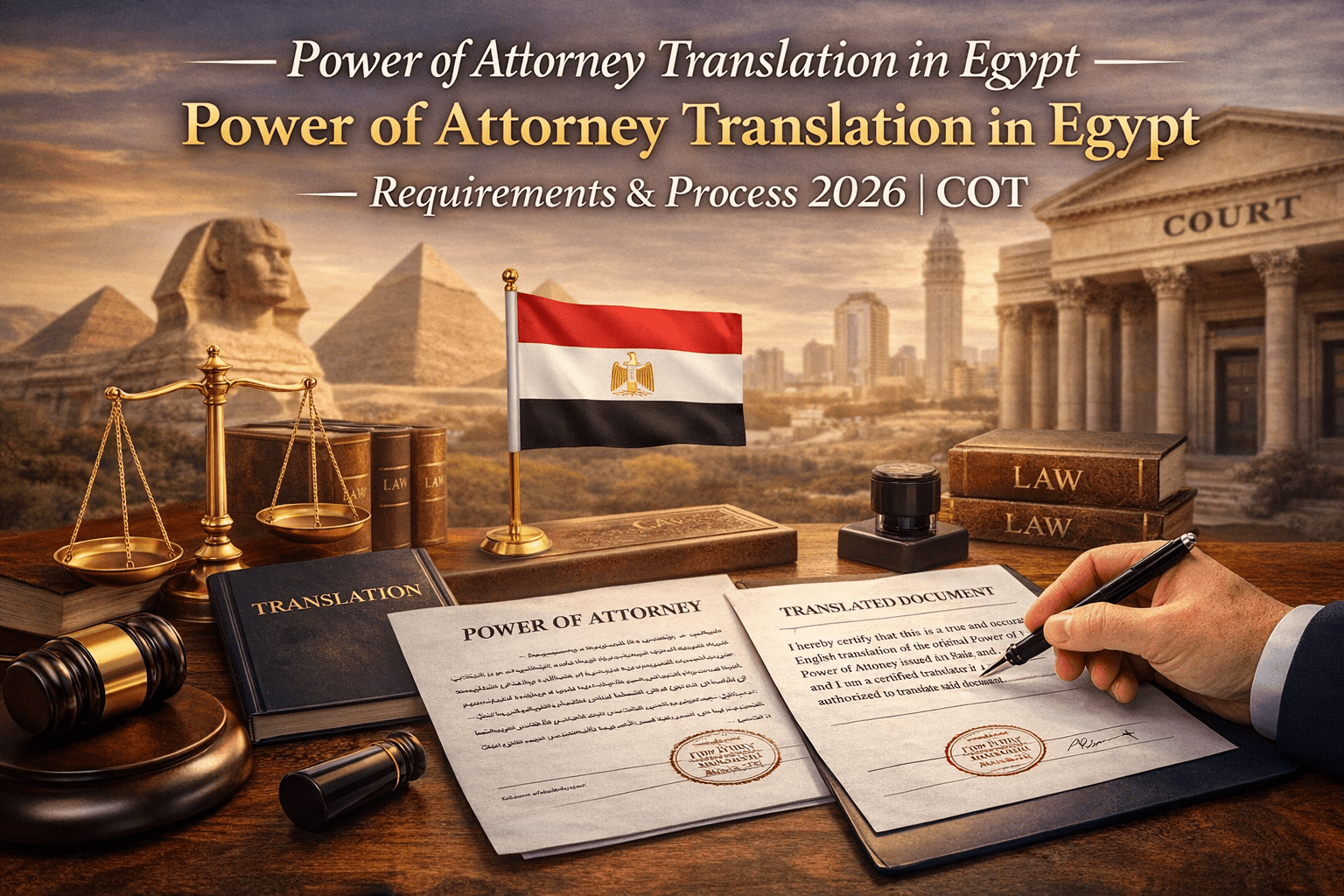
We have published a comprehensive guide on this topic: Power of Attorney Translation in Egypt — Requirements & Process 2026. This article covers every type of POA, the legalization steps, and the specific requirements for property-related POAs at the الشهر العقاري and courts.
Common types of POA that foreign property buyers need translated include:
- General Power of Attorney — broad authority to act on all legal matters.
- Special Power of Attorney — limited to a specific transaction, such as purchasing a named property.
- Property Registration POA — specifically authorizing the representative to complete registration at the الشهر العقاري.
- Company POA — when a foreign company authorizes an individual to act on its behalf in a real estate transaction.
6. Translation for GAFI, Tax Authority, and Investment Bodies
Foreign investment in Egyptian real estate often involves interaction with the General Authority for Investment and Free Zones (GAFI), the Egyptian Tax Authority, and the Social Insurance Authority. Each of these bodies has its own documentation requirements, and all submitted documents must be in Arabic.
If you are setting up a company in Egypt to hold property, or if your purchase is part of a larger investment project, you will need certified translation of:
- GAFI incorporation documents and board resolutions
- Tax registration applications and tax returns
- Social insurance registration forms (if employing staff)
- Investment agreements and shareholder contracts
- Bank reference letters and financial statements
Our team at COT has extensive experience with legal contract translation for GAFI, tax, and corporate entities, ensuring your documents meet the exact format and language requirements of each authority.
For foreign nationals managing multiple aspects of life in Egypt — from property to residence permits to business registration — our expat translation services guide provides a complete overview of every document you may need translated.
7. The Legalization Process for Foreign Real Estate Documents
When a foreign buyer brings documents from outside Egypt (such as a POA issued in the UK, a company registration from the UAE, or financial statements from a US bank), those documents must go through a legalization process before they are accepted by Egyptian authorities.
The standard legalization path for foreign documents used in Egyptian real estate transactions is:
- Notarization in the country of origin — the document is notarized by a public notary or equivalent authority.
- Authentication by the Ministry of Foreign Affairs (or equivalent) in the country of origin.
- Legalization by the Egyptian Embassy or Consulate in that country.
- Legalization by the Egyptian Ministry of Foreign Affairs upon arrival in Egypt.
- Certified Translation into Arabic by an accredited Egyptian translation office.
- Submission to the relevant Egyptian authority (الشهر العقاري, courts, GAFI, etc.).
For countries that are members of the Hague Apostille Convention, the process may be simplified with an Apostille stamp replacing the embassy legalization step. However, Egypt is not currently a member of the Hague Convention, so the full legalization chain is generally required.
COT Translation can guide you through the entire legalization process and ensure your documents are properly certified for use in Egyptian real estate transactions. If you are applying for a visa alongside your property purchase, you may also need certified translation for Schengen visa or certified translation for UK visa from Egypt.
8. 7 Common Translation Mistakes Foreign Buyers Make
Based on our 30+ years of experience handling real estate translations, these are the most common and costly mistakes we see foreign property buyers make:
- Using an uncertified translator — Documents translated by a non-accredited translator will be rejected by Egyptian courts and the الشهر العقاري. Always use a certified translation office recognized by the Ministry of Justice.
- Translating only part of the document — Egyptian authorities require the complete document to be translated, including stamps, seals, and handwritten notes. Partial translations are rejected.
- Ignoring the legalization chain — Many buyers have their documents translated before completing the required legalization steps. The correct order is: notarization → authentication → embassy legalization → Ministry of Foreign Affairs → certified translation.
- Using machine translation for legal documents — Google Translate and AI tools cannot produce legally valid certified translations. Real estate contracts contain nuanced legal language that requires human expertise and official certification.
- Not verifying property-specific terminology — Egyptian real estate law uses specific Arabic terms that differ from standard legal Arabic. A translator unfamiliar with property law may use incorrect terms that change the legal meaning of a clause.
- Delaying translation until the last minute — Rush translations increase the risk of errors. Starting the translation process early gives you time for review and any necessary corrections.
- Not keeping certified copies of all translated documents — Always request multiple certified copies of your translations. You may need them for the الشهر العقاري, your bank, your lawyer, and your own records.
For more on why certified human translation is essential and cannot be replaced by AI, read our article: Will AI Replace Human Translators?
9. What Our Clients Say About COT Translation
COT Translation has served thousands of clients across our branches in Cairo, including foreign property buyers, law firms, investment companies, and individual expats. Here is what some of our clients have to say:
★★★★★
“COT is highly-qualified and always provides accurate, timely and dependable services in whatever language is needed.”
— International Business Client, Cairo
“COT is highly-qualified and always provides accurate, timely and dependable services in whatever language is needed.”
— International Business Client, Cairo
★★★★★
“The service provided by COT was very professional and quick. I am thoroughly satisfied with the deliverables and would definitely recommend them for any translation requirements.”
— Property Buyer, Google Reviews
“The service provided by COT was very professional and quick. I am thoroughly satisfied with the deliverables and would definitely recommend them for any translation requirements.”
— Property Buyer, Google Reviews
★★★★★
“I contacted COT to provide English and French certified translation of nearly 30 pages. They were fast and very professional. Best certified services.”
— Client Review, Downtown Cairo Branch
“I contacted COT to provide English and French certified translation of nearly 30 pages. They were fast and very professional. Best certified services.”
— Client Review, Downtown Cairo Branch
★★★★★
“المكتب ده معاملته حلوة جدا ويتميز بالدقة في ترجمته وسرعة الأداء وعن تجربة شخصية وأوصي من يحتاجون إلى ترجمة سريعة ومعتمدة ودقيقة بالتعامل معه”
— عميل من فرع المعادي
“المكتب ده معاملته حلوة جدا ويتميز بالدقة في ترجمته وسرعة الأداء وعن تجربة شخصية وأوصي من يحتاجون إلى ترجمة سريعة ومعتمدة ودقيقة بالتعامل معه”
— عميل من فرع المعادي
★★★★★
“Fastest and best Translation Company. The quality of the translation I received was of good quality and the timeliness of the work was excellent.”
— Client Review, Mohandeseen Branch
“Fastest and best Translation Company. The quality of the translation I received was of good quality and the timeliness of the work was excellent.”
— Client Review, Mohandeseen Branch
★★★★★
“ناس محترفين في الترجمة وسعرهم كويس جدا وخلصولي الشغل في نفس اليوم اول ما عرفوا أني عندي موعد في السفارة ومن غير رسوم مستعجل بصراحة قمة في الذوق”
— عميل من فرع وسط البلد
“ناس محترفين في الترجمة وسعرهم كويس جدا وخلصولي الشغل في نفس اليوم اول ما عرفوا أني عندي موعد في السفارة ومن غير رسوم مستعجل بصراحة قمة في الذوق”
— عميل من فرع وسط البلد
These reviews reflect the consistent quality, speed, and professionalism that COT delivers across all of our Cairo branches. Whether you visit us in Downtown Cairo, Maadi, or Mohandeseen, you will receive the same high standard of certified translation services.
10. Why Choose COT for Real Estate Translation in Egypt
COT Translation — the Consulting Office for Translation — is one of Egypt’s most established and trusted certified translation offices, with over 30 years of experience and official accreditation from all Egyptian embassies, the Ministry of Justice, courts, and government bodies. Here is why foreign property buyers trust us with their most important documents:
- Official Accreditation — COT is recognized by all embassies in Egypt, the Ministry of Foreign Affairs, all Egyptian courts, and the Real Estate Publicity Department (الشهر العقاري). Our translations are accepted without question by every official body in Egypt.
- Specialized Real Estate Translators — Our team includes translators with deep expertise in Egyptian property law, contract terminology, and registration procedures. They know the exact language required by the الشهر العقاري and courts.
- 120+ Languages — Whether your documents are in English, French, German, Chinese, Russian, Turkish, Italian, or any other language, we provide certified translation to and from Arabic in over 120 languages.
- Three Cairo Branches — Visit us at our Downtown Cairo, Maadi, or Mohandeseen branches for in-person service, or use our online and WhatsApp ordering for remote convenience.
- Fast Turnaround with Urgent Service — We understand that real estate transactions often have tight deadlines. COT offers same-day and urgent translation services with no compromise on quality.
- Complete Legalization Support — Beyond translation, we guide clients through the full legalization chain for foreign documents, saving you time and preventing costly errors.
- Transparent Pricing — No hidden fees. We provide a clear quote before starting any work, and our prices are competitive across all translation categories.
- 30+ Years of Trust — More than 50,000 companies, institutions, and individuals have trusted COT for their certified translation needs. Our track record speaks for itself.
Ready to Protect Your Property Investment in Egypt?
Contact COT Translation today for a free quote on your real estate documents.
📞 (+20) 1205444602 | ✉️ operation@cottranslation.com
11. Frequently Asked Questions
Can a foreign national buy property in Egypt?
Yes. Egyptian law allows foreign nationals to purchase property in Egypt, subject to certain restrictions. Foreign buyers may own up to two residential properties, and the property must not be located in certain restricted areas (such as border zones). The total area is also limited. Specific rules may vary, so consulting a local lawyer alongside your translation office is always recommended.
Do I need to translate my passport to buy property in Egypt?
Yes. A certified Arabic translation of your passport is required for submission to the الشهر العقاري, courts, and other government bodies involved in the property registration process.
How long does real estate document translation take?
Standard turnaround for a typical property contract is 1–3 business days. For urgent needs, COT offers same-day and express translation services. Complex documents (such as multi-page company registrations or technical reports) may require additional time.
Can I use the same translation for multiple government bodies?
Yes, as long as the translation is certified and stamped by an accredited translation office. However, some authorities may require original certified copies rather than photocopies. We recommend ordering multiple certified originals from the start.
What if my documents are in a language other than English?
COT Translation handles over 120 languages. Whether your documents are in French, German, Chinese, Russian, Turkish, Spanish, Italian, or any other language, we provide certified translation directly into Arabic without the need for an intermediate English translation.
Is online ordering available for real estate translation?
Yes. You can send your documents via WhatsApp or email, receive a quote within minutes, and have your certified translation delivered to your door anywhere in Egypt. You can also visit any of our three Cairo branches for in-person service.
Related Articles from COT Translation