- محمد امام عبد الرحيم
- Australian Embassy, Canadian Embassy, certified translation, certified translation Egypt, COT translation, document translation, embassy documents, Embassy Translation, Embassy Translation Rejection, French Embassy Cairo, German Embassy Cairo, immigration translation, Italian Embassy Cairo, Spanish Embassy Cairo, translation for embassies, US Embassy Cairo, Visa Application, visa translation
- 0 Comments
- 3145 Views
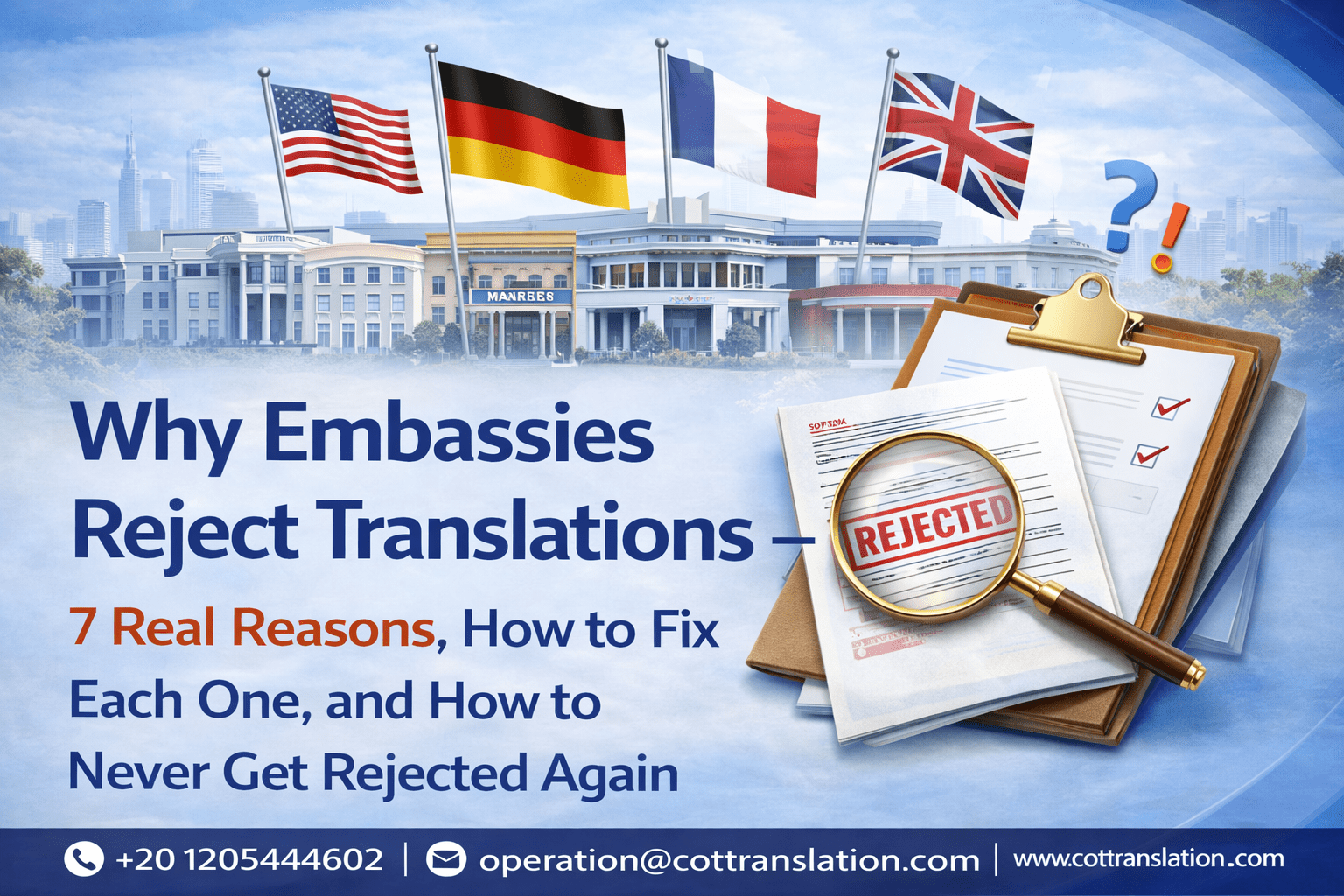
Why Embassies Reject Translations — 7 Real Reasons, How to Fix Each One, and How to Never Get Rejected Again
You spent weeks gathering documents. Then you paid for a translation. You booked an appointment at the embassy. And then — rejection. A single line telling you your translation was not accepted, with little explanation of why. It happens more often than most people realize, and in almost every case, the reason is preventable. After 30+ years of translating documents for embassies in Egypt, we have seen the same mistakes happen over and over — at the German Embassy in Cairo, the US Embassy, the Canadian Embassy, the Australian Embassy, and others.
What this article covers: The 7 most common reasons embassies reject translations (with real examples), what each embassy specifically looks for, a complete pre-submission checklist, and exactly how to avoid rejection from the first visit.
📋 Table of Contents
- Part 1 — The 7 Reasons Embassies Reject Translations
- Reason 1: The translator is not recognized by the embassy
- Reason 2: Inconsistent name spelling across documents
- Reason 3: Incomplete translation — missing stamps, seals or handwritten notes
- Reason 4: The translation is too old
- Reason 5: Machine translation or unverified online translation
- Reason 6: Missing apostille or legalization on the original document
- Reason 7: Wrong document version translated
- Part 2 — What Each Embassy Specifically Requires (DE, US, CA, AU, FR, ES, IT)
- Part 3 — The Complete Pre-Submission Checklist
- Frequently Asked Questions
Part 1 of 3
The 7 Reasons Embassies Reject Translations
Embassy rejections due to translation issues almost always fall into one of these seven categories. Understanding them will save you weeks of waiting and the cost of a second appointment.01
The translation office or translator is not recognized by the embassy
This is the most common reason — and the most frustrating, because the translation itself may be perfectly accurate. Embassies maintain their own lists of approved or recognized translation offices. Embassies reject translations from unrecognized offices outright, no matter how good the quality.
This rule is strictest at the German Embassy in Cairo when the embassy itself legalizes a translation: the translator must then appear on its list. For standard visa files at TLScontact, certified translations are usually enough. The US Embassy has a different approach — it does not maintain a public approved list but requires a signed certification statement from the translator, which many offices do not include.
❌ Real example from the market
An applicant submits a birth certificate translated by a small neighborhood translation shop. The translation is accurate and stamped. The German Embassy rejects it because the office is not on their approved list. The applicant must retranslate the entire document with a recognized office and rebook the appointment.
✅ The fix
Always verify that the translation office you use is on the specific embassy’s approved list before ordering. Clients use COT Translation for German visa files at TLScontact, US Embassy applications and other embassy files in Egypt. Our stamp and signature follow the format these files require.
02
Inconsistent name spelling across documents
Arabic names do not transliterate into English, German, or French in a single standardized way. The name محمد can appear as Mohamed, Muhammad, Mohammed, or Mohammad. The name عبد الرحمن can appear as Abdel Rahman, Abd El-Rahman, Abdelrahman, or Abdul Rahman.
If your name appears differently across your passport, birth certificate translation, and marriage certificate translation, the embassy officer will flag it as a potential discrepancy — even if all three documents clearly refer to the same person.
❌ Real example from the market
An applicant’s passport reads “Mohamed Abdel Aziz.” His birth certificate translation, done by a different office last year, reads “Muhammad Abd Al-Aziz.” His marriage certificate translation reads “Mohammed Abdulaziz.” Three documents, three spellings. The US Embassy requests a clarification letter, delaying the visa by six weeks.
✅ The fix
Before translating any document, provide the translator with a copy of your passport. The name spelling in the passport is the legal standard — all translations must use the exact same spelling. At COT, we run a mandatory name consistency check against the passport before finalizing any document.
03
Incomplete translation — missing stamps, seals, or handwritten notes
A certified translation is not just a translation of the printed text. It must be a complete representation of the entire document — including every official stamp, every seal, every handwritten annotation, every marginal note, and every correction. Embassies expect the translation to account for every element visible on the original.
Egyptian official documents are particularly complex in this regard. A birth certificate can carry three or four different government stamps, a handwritten date correction, an official seal from the Civil Registry, and a marginal note added years later. The translator must translate and describe all of these.
❌ Real example from the market
A marriage certificate has a marginal annotation in Arabic that records a name change from an earlier marriage. The translator skips it, considering it irrelevant. The German Embassy notices the untranslated annotation, rejects the document, and asks for a full retranslation — including an explanation of the annotation.
✅ The fix
When submitting documents for translation, send a high-resolution scan — not a quick phone photo. Every stamp and annotation must be legible. A professional translation office will describe every element: “[Official seal of the Cairo Civil Registry]”, “[Handwritten correction: date amended from 15/3 to 05/3]”, etc.
Need a translation that embassies will accept — first time?
📞 01111760177 · ✉️ operation@cottranslation.com
04
The translation is too old
Many applicants make a practical mistake: they have a document translated years ago for one purpose and try to reuse it for a new application. Embassies often impose a validity period on translated documents — typically 3 to 12 months depending on the document type and the embassy.
This is especially common with documents like police clearance certificates (صحيفة الحالة الجنائية), income certificates, and employment letters — all of which are considered time-sensitive by nature.
❌ Real example from the market
An applicant had his police clearance certificate translated 14 months ago for a previous visa application. He submits the same translation for a new application. The Canadian Embassy rejects it — their policy requires police clearance translations to be no older than six months. He must obtain a new clearance certificate and have it retranslated.
✅ The fix
Always check the specific embassy’s validity requirements for each document type before your appointment. As a rule: if the original document is time-sensitive, the translation should be fresh. Do not translate a document more than 60 days before you plan to submit it.
05
Machine translation or unverified online translation services
With the rise of AI translation tools and cheap online services, more applicants are submitting machine-generated translations — sometimes without even realizing it. Some online “translation services” use Google Translate or DeepL as their actual translation engine, then add a stamp and sell it as certified. Embassies are increasingly skilled at identifying these.
The tells are obvious to a trained officer: unnatural sentence structures, inconsistent terminology, mistranslated legal terms, names rendered as common nouns, and dates formatted incorrectly. Beyond the quality issues, no machine translation service can produce a legally valid certification statement.
❌ Real example from the market
An applicant uses a cheap online service that charges very little per page. The service uses automated translation and adds a generic stamp. The word خلع (a specific type of Islamic divorce) is translated as “removal” — its literal dictionary meaning. The German Embassy’s visa officer, familiar with Islamic family law terminology, immediately identifies the error and rejects the document.
✅ The fix
Only use human translators with subject-matter expertise. For legal documents, the translator must understand the legal system behind the document — not just the language. For a medical report, the translator must know medical terminology. A cheap generalist translation of a specialized document will almost always contain errors that a trained embassy officer will catch.
06
Missing apostille or legalization on the original document
This is technically an issue with the original document rather than the translation itself — but it results in the same outcome: your application is rejected, and the translation cannot be accepted regardless of its quality. Many applicants do not realize that a translation alone is not sufficient. You must also authenticate the original document through the correct official channel.
Egypt and most European countries, including Germany, Austria, and the Netherlands, are signatories to the Hague Apostille Convention. This means Egyptian documents destined for these countries need an apostille from the Egyptian Ministry of Foreign Affairs — not a simple notarization.
❌ Real example from the market
An applicant submits a perfectly translated and certified Egyptian divorce certificate. However, the original certificate only has a notarization from a local notary — not an apostille from the Ministry of Foreign Affairs. The German Embassy rejects the entire package and asks the applicant to obtain the apostille before resubmitting. This adds 3–4 weeks to the process.
✅ The fix
For documents going to apostille-convention countries (Germany, USA, Canada, Australia, UK, Netherlands, France, etc.): obtain the apostille from the Egyptian Ministry of Foreign Affairs BEFORE having the document translated. Some embassies want the apostille on the original; others want it alongside the translation. Always confirm the specific requirement for your target country.
07
Wrong document version translated
Egyptian civil documents exist in multiple versions — short form and long form. Embassies almost always require the long form (the extended version with full parental data and all annotations). Applicants often submit the short form because it is easier to obtain, not realizing the embassy will reject it.
Similarly, some applicants translate an unofficial copy or a photocopy instead of the original official document. Embassies require certified translations of the official, officially-issued original — not copies or unofficial printouts.
❌ Real example from the market
An applicant submits a translated short-form birth certificate (ملخص شهادة الميلاد). The Australian Embassy requires the long-form birth certificate (شهادة الميلاد المطولة) with full parental details. You lose the translation — the applicant must obtain the correct document from the Civil Registry and retranslate it.
✅ The fix
Before translating any document, ask the embassy — or a professional translation office — which version of the document they require. For Egyptian birth certificates: always get the long form. For Egyptian criminal records: make sure it is the official judicial record (صحيفة الحالة الجنائية) issued by the Ministry of Justice, not a local police statement.
Got rejected? We can review your documents and fix the issue.
Send us your documents on WhatsApp — free assessment within minutes.
Part 2 of 3
Need help with your documents? Send them on WhatsApp — you’ll get a quote in minutes.
WhatsAppCall UsWhat Each Embassy in Cairo Specifically Requires
Each embassy has its own rules — and while the 7 reasons above apply universally, the specific requirements vary. Here is what the seven most-visited embassies in Cairo look for.🇩🇪
German Embassy Cairo
- Recognized offices only — The German Embassy maintains a list of approved translation offices in Cairo. For translations the embassy itself legalizes, it rejects offices that are not on the list.
- Direct Arabic–German translation required — The embassy does not accept translations routed through English as a relay language. The translator must be a direct Arabic–German specialist.
- Long-form documents required — Birth certificates, marriage certificates, and divorce decrees must be the full official version, not the summary form.
- Islamic legal terms must be explained — Terms like مهر (Mahr), خلع (Khula), and طلاق (Talaq) must be translated with contextual explanation, not simplified to generic equivalents.
- Apostille required on Egyptian originals for most document types.
- Name consistency — All names must match the passport exactly, using the transliteration that appears in the passport.
🇺🇸
US Embassy Cairo
- No public approved list — The US Embassy does not publish an official list of approved translators. However, the translator must include a signed certification statement confirming their competence in both languages and the accuracy of the translation.
- Certification statement is mandatory — Without a signed certification statement by the translator, the embassy will reject the document. This statement must include the translator’s full name, contact information, and language pair.
- No expiry for most documents — Unlike some other embassies, the US Embassy does not impose a strict validity period on most translated documents — but time-sensitive originals (like police clearances) must still be current.
- All text must be translated — Including stamps, seals, and printed form text. Leaving any element untranslated is grounds for rejection.
- Egyptian police clearance — Must be the official صحيفة الحالة الجنائية from the Ministry of Justice — not a local police statement.
🇨🇦
Canadian Embassy / IRCC Applications from Egypt
- Translation by a certified translator — Canada requires translations to be done by a certified translator who is a member of a professional translation association. COT meets this requirement.
- Affidavit for non-certified translators — If the translator is not a member of a certified association, an affidavit sworn before a notary public is required. This adds cost and time.
- Police clearance validity — The Canadian immigration authority (IRCC) generally requires police clearances no older than 6 months at the time of application. Plan your timeline accordingly.
- Both original and translation must be submitted — IRCC requires the translated document to be submitted alongside a copy of the original. Do not submit the translation alone.
- English or French only — Translations must be into English or French. If your original Arabic document was translated into a third language, retranslate directly into English or French.
🇦🇺
Australian Embassy / Department of Home Affairs Applications
- NAATI-accredited translators preferred — Australia’s National Accreditation Authority for Translators and Interpreters (NAATI) is the official standard. For applications from Egypt, translations by NAATI-recognized or equivalent internationally recognized offices are accepted.
- Long-form birth certificates mandatory — Embassies consistently reject short-form certificates. Always obtain and translate the full long-form version.
- No relation to the applicant — The translator must not be a family member or person known to the applicant. A signed declaration of independence is sometimes required.
- Police clearance — The Egyptian police clearance must be issued by the Ministry of Justice (وزارة العدل), not a local police station. The translation must cover the full document, including all official stamps.
🇫🇷
French Embassy Cairo (Visa France / Campus France)
- Sworn translator required for legal documents — For visa applications, the French Embassy requires translations by a sworn translator (traducteur assermenté) or by an office recognized by the French authorities.
- Direct Arabic–French translation preferred — Like the German Embassy, the French authorities prefer direct translation without relay through English. Translate Arabic documents directly into French.
- Campus France applications — For student visa applications processed through Campus France Egypt, all academic documents (transcripts, diplomas, degree certificates) must be translated into French by a recognized office. The translation must match the original document format.
- Civil status documents — Birth certificates, marriage certificates, and family composition documents (وثيقة الحالة العائلية) must include full parental information. Short-form documents are not sufficient.
- Apostille required — Egypt and France are both signatories to the Hague Convention. Egyptian documents destined for France need an apostille from the Ministry of Foreign Affairs before submission.
- Police clearance — Must be the official judicial record from the Ministry of Justice, translated in full including all stamps, within 3 months of the application date.
🇪🇸
Spanish Embassy Cairo (Embajada de España)
- Certified translation into Spanish required — The Spanish Embassy requires translations into Spanish by a certified translator. Spain is a Hague Convention signatory, so apostilled Egyptian originals are accepted without further legalization.
- Official translator registration — Spain’s Ministry of Foreign Affairs maintains a register of official translators (traductores-intérpretes jurados). For applications processed in Spain, this registration is mandatory.
- Family reunification documents — For Egyptians joining family members in Spain, the required documents include birth certificates, marriage certificates, and proof of family relationship — all translated into Spanish and apostilled.
- Academic degree recognition (homologación) — Egyptians seeking to have their degrees recognized in Spain must submit certified Spanish translations of their diplomas and transcripts to the Spanish Ministry of Education. This is a separate process from the visa application and has strict formatting requirements.
- Criminal record certificate — Must be issued by the Egyptian Ministry of Justice and translated into Spanish. Most Spanish visa types require this to be no older than 3 months.
- Marriage certificates with Islamic clauses — For mixed Egyptian-Spanish couples, Islamic contract terms (Mahr, Wali, witnesses) must be fully explained in the Spanish translation — not abbreviated or omitted.
🇮🇹
Italian Embassy Cairo (Ambasciata d’Italia)
- Legalisation through the Italian Embassy — Italy requires Egyptian documents to be legalized through the Italian Embassy in Cairo (or apostilled, since both countries are Hague Convention signatories). Order the translation only after the legalization/apostille is in place.
- Certified translation into Italian required — All documents must be translated into Italian. The translation must carry the translator’s certification and be produced by a recognized office.
- Nulla Osta process — For family reunification visas and marriage visas, a Nulla Osta (authorization) is required from the Italian authorities. Supporting documents, including birth certificates and criminal records, must be translated into Italian and properly certified.
- Academic qualifications — For study visa applications, you need Italian translations of transcripts and diplomas. The Italian Ministry of Education (MUR) process for degree recognition also requires certified Italian translations.
- Civil documents — strict format — The Italian civil registry system is highly formalized. Birth and marriage certificates must be translated in a way that maps clearly to Italian civil document conventions — a direct word-for-word translation is often not sufficient without structural adaptation.
- Police clearance — The Italian Embassy requires the official Egyptian judicial record from the Ministry of Justice, translated into Italian in full, generally no older than 6 months.
Applying to a specific embassy? We know exactly what they need.
German, US, French, Spanish, Italian, Canadian, Australian — 30+ years of embassy files in Cairo.
Part 3 of 3
The Complete Pre-Submission Checklist — Never Get Rejected Again
Use this checklist every time you prepare a translation package for an embassy application. Go through it document by document before your appointment.Before You Order the Translation
- Confirm the translation office is on the specific embassy’s approved list (or meets their certification requirements)
- Obtain the correct version of each document — long-form birth certificate, official judicial criminal record, etc.
- Check that the original document is currently valid and not expired
- Obtain the apostille from the Egyptian Ministry of Foreign Affairs if required by the target country
- Gather a clear, high-resolution scan of every document — all stamps and annotations must be legible
- Provide the translator with a copy of your passport for name consistency checking
When You Receive the Translation
- Check that your name is spelled exactly as it appears in your passport — in every translated document
- Verify that all stamps, seals, and handwritten notes are described in the translation
- Confirm the translation includes a signed certification statement by the translator
- Check that dates are correctly converted (Hijri to Gregorian if applicable)
- Verify that the translation is dated and that the date is within the embassy’s validity window
- Do not accept a translation that skips any stamps or annotations — even if they seem unimportant
- Do not use the same translation for a new application if more than 6–12 months have passed
Before Your Embassy Appointment
- Bring both the original document and the certified translation
- Keep all documents in the same order and attached together (original + translation for each document)
- Double-check that name spellings are consistent across all documents
- Confirm the apostille (if required) is attached to the correct original
- If any document name differs from your passport, prepare a brief written explanation
✅ One final tip: If you are unsure about any requirement — call the embassy before your appointment, or ask your translation office. A reputable translation office like COT will advise you on exactly what each embassy requires before you even place your order. This costs nothing and can save weeks of delays.
Make sure your translation is accepted — the first time
For over 30 years, clients have used COT Translation’s work in files for the major embassies in Cairo. Send us your documents and we will tell you exactly what you need — before you order anything. Free Quote WhatsApp📞 01111760177 | ✉️ operation@cottranslation.com
Frequently Asked Questions
Can I reuse a translation I had done two years ago?
It depends on the document type and the embassy. For static documents like birth certificates, many embassies will accept older translations. For time-sensitive documents like police clearances, income certificates, or employment letters, you will almost certainly need a fresh translation of a new original. When in doubt, get a new translation — it is far cheaper than a rejected application.What happens if my name is spelled differently in different documents?
The embassy officer will flag the discrepancy. In some cases they will ask you to submit a clarification letter or affidavit explaining that all spellings refer to the same person. In other cases they may reject the application outright. The safest approach is to standardize all name spellings to match your passport before submitting.Does the German Embassy in Cairo have a list of approved translators?
Yes. The German Embassy Cairo maintains a list of recognized translation offices. The embassy legalizes translations only from offices on this list. COT Translation is on this list. You can verify the list on the German Embassy Cairo’s official website, or ask COT directly.My translation was rejected. Can COT fix it?
Yes. Send us the rejection notice and your documents via WhatsApp. We will assess the issue and tell you exactly what needs to be corrected or retranslated. In most cases we can produce a corrected, embassy-accepted translation within 24 hours.Is an online or AI translation accepted by embassies?
No. Embassies require certified human translations with a signed certification statement. Machine translations — even high-quality ones — do not carry legal validity and cannot include the required certification. Using an AI or online translation for an official application is a guaranteed rejection.Do I need an apostille on my Egyptian documents before translating?
For documents going to apostille-convention countries (Germany, USA, Canada, Australia, UK, etc.): yes, in most cases. The apostille goes on the original document and confirms its authenticity. We then translate the apostilled original. Some embassies require the apostille before the translation; others accept both simultaneously. Always confirm with the specific embassy.How long does it take to get a translation corrected?
Standard documents (birth certificate, marriage certificate, criminal record): 1–3 hours. Complex documents with multiple pages or specialized legal content: 24–48 hours. Rush service is available. We can deliver the corrected translation as a stamped PDF by email and as a physical original by courier.Related Articles from COT Translation
Need Help with Embassy Translation Rejection?
Specialist human translators since 1992 · 120+ languages · Maadi · Mohandessin · Downtown Cairo
WhatsAppCall Us